Niche Market SEO: 5 Steps That Beat Competing on Volume
Niche market SEO is the only realistic path for a site with no authority. Here are the five steps I use to find and win keywords that bigger competitors will never bother to target.

If your site has low authority, competing for head terms is a waste of a year.
Niche market SEO is the alternative, and it is the only approach I have seen reliably work for new sites and small businesses. Here are the five steps.
Step 1: Find the Queries Your Competitors Are Too Big to Want
Large sites target volume. That leaves an enormous amount of specific, low volume, high intent search unclaimed.
The pattern to look for is a question a customer asks you on the phone that no page on the internet answers well. Those queries have small volume and almost no competition.
Ten queries at fifty searches a month each, all from people ready to buy, beats one query at five thousand searches you will never rank for.
Step 2: Check Who Is Actually Ranking, Not the Difficulty Score
Difficulty scores are a rough proxy. The real check takes ninety seconds: search the term and look at what is on page one.
If the results are forums, a Reddit thread, and two thin affiliate pages, that keyword is available regardless of what the score says. If the results are five established sites with genuinely good pages, move on.
I have won plenty of terms with a high difficulty score because the actual results were weak, and lost easy-looking ones where the incumbents were excellent.
Step 3: Write the Page That Deserves to Win
For a niche query, deserving to win usually means being the only page that answers the specific question completely.
That means naming specifics, including the edge cases, and covering the part everyone else skips. Length is not the variable. Completeness on one narrow question is.
The page should answer the query in the first paragraph and then earn the rest of the reader's time.
Step 4: Build a Cluster, Not a Page
One page on a niche topic ranks for one thing. Eight interlinked pages on adjacent narrow questions start to establish topical relevance, and that relevance lifts all of them.
This is the part that compounds. Each new page in the cluster makes the others slightly more credible to a search engine.
Link them to each other deliberately, with descriptive anchor text, and link the cluster to whatever service page they support.
Step 5: Expand Upward Only After You Win Down
Once the cluster ranks, the site has earned enough relevance to attempt slightly more competitive terms in the same topic.
This is the sequencing that most people get backwards. They start at the head term, fail for a year, and conclude SEO does not work.
Start where you can win in eight weeks. Use those wins to earn the right to compete for the next tier.
What This Requires That People Underestimate
Patience with small numbers. A page getting forty visits a month looks like failure on a dashboard and can be the most profitable page on the site if those forty people are buyers.
Judgment about intent. Volume is easy to measure and intent is not. The queries worth targeting are the ones where the searcher has a problem you charge money to solve.
And a realistic timeline. Organic results have a long lag, which is the entire reason I built the Latency Ladder.
Where to Start
Write down the twenty questions customers actually ask you. Search each one. Find the five where the existing results are bad.
That list is your first quarter. It is not glamorous and it works far more reliably than chasing a head term.
The tools side of this is covered in the SEO tools I use to grow organic traffic, and for local businesses specifically, how to improve your local SEO scores is the more relevant starting point.
For keyword data, Google Search Console shows you queries you already rank for on page two, which is the cheapest niche keyword list available and almost nobody mines it.
How Long Does Niche Market SEO Take to Work?
Eight to twelve weeks for the first rankings on genuinely low competition terms, and six months before the cluster produces meaningful traffic. That is dramatically faster than competing for head terms, which is the entire argument for doing it this way.
The sequence usually looks the same. A few pages appear on page two within a month, one or two reach page one around week eight, and the rest follow as the cluster establishes topical relevance. Nothing happens in the first three weeks and that is normal.
What changes the timeline most is existing site authority. A brand new domain sits in the slow lane regardless of content quality, and there is no way to buy your way out of it that does not create bigger problems later.
The mistake that resets the clock is impatience. Publishing eight pages, seeing nothing at week four, and pivoting to a different topic means you never accumulate relevance in either. The cluster only works if you finish it.
What to watch in the meantime: impressions rather than clicks. A page collecting impressions at position 30 is being indexed and evaluated, and it is on a normal trajectory. A page with no impressions after six weeks has a different problem, usually technical, and that is worth investigating immediately.
What question do your customers ask that you have never written a page about? That is usually the first one to do.
More notes
Decentralized Search and SEO: What Actually Changed
Decentralized search was going to break Google's monopoly and rewrite SEO. It did not happen, but search did fragment in a way nobody predicted, and that fragmentation is the thing worth preparing for.
SEOWeb3 Domains: An Honest Guide to What They Actually Do
Web3 domains were sold as the replacement for the traditional DNS system. Years later, here is what they actually do, the one real use case, and why I would not buy one for a business website.
 SEO
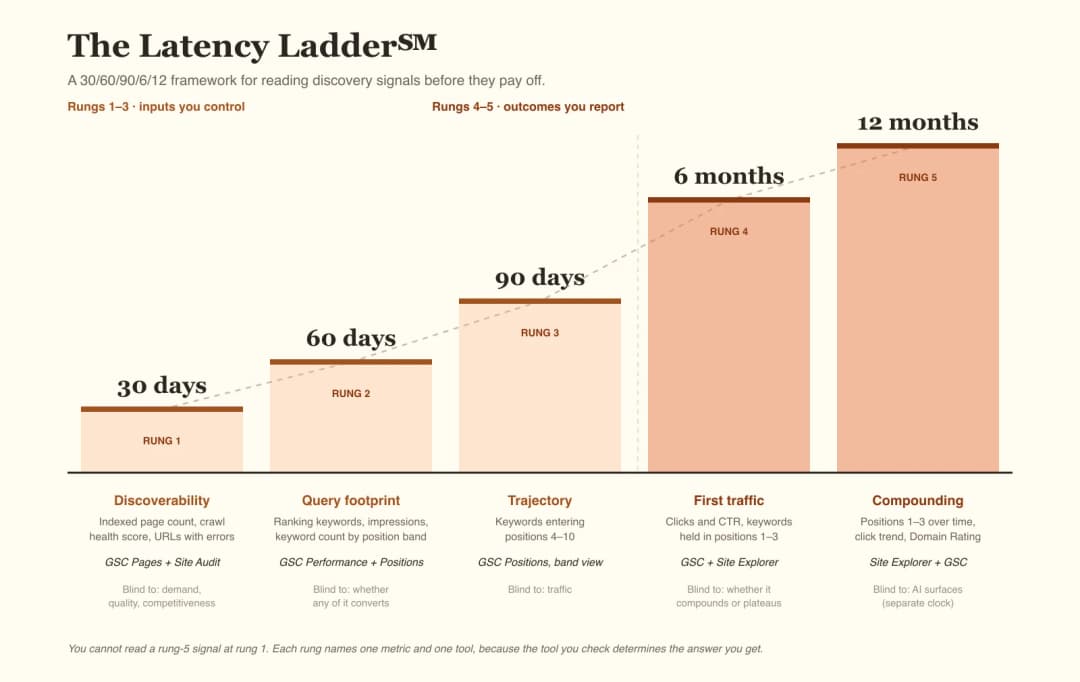
SEOThe Latency Ladder℠: A 30/60/90/6/12 Framework for Reading Discovery Signals
Clients and stakeholders always ask whether you are ranking yet, and whether AI is citing you. After nearly ten years of getting those questions, here is the framework I use to track, report, and prove the value of SEO and AI optimization — tested against my own Search Console data.
SEOWeb2 vs Web3 for Marketers: An Honest Retrospective
I wrote a lot about web3 when it was going to replace the internet. It did not. Here is the honest retrospective on web2 vs web3, what actually survived, and the two ideas still worth paying attention to.