Web2 vs Web3 for Marketers: An Honest Retrospective
I wrote a lot about web3 when it was going to replace the internet. It did not. Here is the honest retrospective on web2 vs web3, what actually survived, and the two ideas still worth paying attention to.

I wrote a lot about web3 during the period when it was going to replace the internet.
It did not. Most of what I wrote aged badly and the honest thing to do is say which parts and why.
What Web2 vs Web3 Was Supposed to Mean
The framing was ownership. Web1 you read, web2 you posted on platforms that owned your work, web3 you would own your content, your identity, and your audience through decentralized infrastructure.
For marketers the promise was direct. No algorithm between you and your audience, no platform that could delete your reach overnight, portable customer relationships.
That was a genuinely appealing pitch to anybody who had watched organic reach collapse on a platform they built a business on.
What Actually Happened
The ownership layer did not arrive for normal users.
Self custody turned out to be too hard. People lost keys, got phished, and eventually moved their assets back onto centralized exchanges, which are structurally identical to the platforms web3 was supposed to replace.
The user experience never got close to acceptable. Every additional step in a signup flow costs conversions, and web3 onboarding added six.
And the speculative layer poisoned the technical one. Real infrastructure work got buried under token schemes, which made serious companies unwilling to touch any of it.
What Survived
Payments in places banking does not reach. Stablecoin settlement for cross border transactions is a real, boring, working use case. It is also the least discussed one.
Provenance for digital goods. Verifiable records of authenticity have durable applications in ticketing, credentials, and supply chain. The technology works. The consumer framing around collectibles is what died.
Decentralized identity, slowly. The idea that you should control your credentials rather than a platform is still correct and it is progressing through standards bodies rather than startups. The W3C's verifiable credentials work is the serious version of this.
The Two Ideas Still Worth Attention
Platform risk is real and web3 identified it correctly. The diagnosis was right even though the cure did not work.
If your business depends on a channel you do not own, you are one policy change from a very bad quarter. The answer turned out to be an email list and a website, which is unglamorous and effective. I got into this in platform risk for marketers.
Portable reputation would change marketing significantly. If reviews and credentials followed a person or a business across platforms rather than being locked inside one, it would reshape local marketing entirely.
That has not happened. It remains the most interesting unrealized idea from the period.
What I Would Tell Someone Now
Do not build marketing strategy on web3 infrastructure. The audience is small, the tooling is unstable, and the reputational association is still negative in most markets.
Do take the platform risk lesson seriously, because that one was correct and most businesses still have not acted on it.
And treat any technology wave with the same question I should have asked harder in 2021: what does this let a normal person do that they could not do before, without learning anything new?
Web3 never had a good answer. That was the tell.
For how this same pattern played out in an adjacent hype cycle, marketing lessons from crypto covers the tactics side, and what happened to the metaverse covers the other half of the same era.
What Should Marketers Take From the Web3 Era?
One durable lesson: audiences you rent can be taken away, and the only reliable fix is owning a direct channel. The decentralization movement diagnosed that correctly and then proposed a cure nobody could use. The workable cure was an email list and a website you control.
The second lesson is about evaluating technology claims generally. Web3 failed a simple test that would have saved a lot of people time and money. Can a normal person get value from this today, without installing software or learning new concepts? The answer was no for years, and enthusiasm kept substituting for that answer.
The third is more uncomfortable. A large number of experienced marketers, including me, wrote confidently about a transition that did not happen. The incentive to have an early opinion on a new thing is strong, and it rewards speed over calibration. I now hold new-technology opinions more loosely and say so in writing when I am uncertain.
What I would not take from it: cynicism about anything new. The same reasoning that correctly dismissed virtual land also caused people to dismiss AI assistants, which turned out to be the genuine shift of the decade.
The discipline is to evaluate each thing against what people currently do, rather than against the last hype cycle. That is harder than pattern matching and it is the only method that works.
The practical residue of the whole era, for an ordinary business, is one sentence: build an email list and publish on a site you control. That was the correct response to the platform risk web3 identified, and it required no new technology at all. The details are in platform risk for marketers.
The discipline that survived is to evaluate each new thing against what people currently do, rather than against the last hype cycle. Pattern matching would have had me dismiss AI assistants for the same reasons I should have dismissed virtual land, and that would have been the more expensive error of the two.
What did you build during that period? I shipped things I would not ship now and I learned more from that than from the projects that worked.
More notes
 SEO
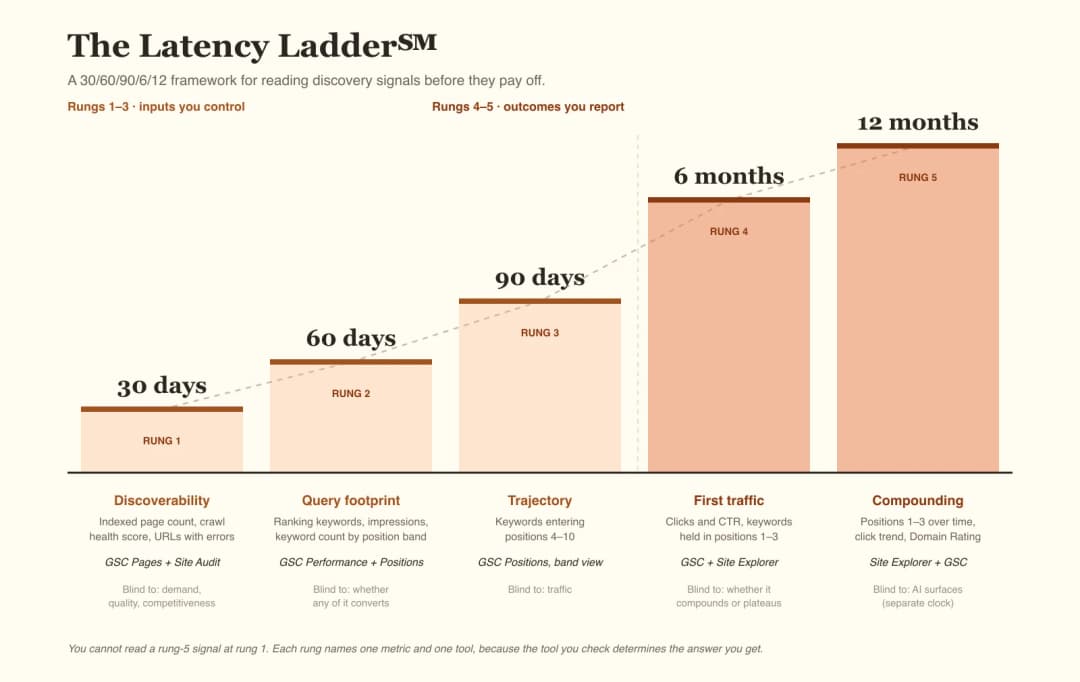
SEOThe Latency Ladder℠: A 30/60/90/6/12 Framework for Reading Discovery Signals
Clients and stakeholders always ask whether you are ranking yet, and whether AI is citing you. After nearly ten years of getting those questions, here is the framework I use to track, report, and prove the value of SEO and AI optimization — tested against my own Search Console data.
SEOWeb3 Domains: An Honest Guide to What They Actually Do
Web3 domains were sold as the replacement for the traditional DNS system. Years later, here is what they actually do, the one real use case, and why I would not buy one for a business website.
SEODecentralized Search and SEO: What Actually Changed
Decentralized search was going to break Google's monopoly and rewrite SEO. It did not happen, but search did fragment in a way nobody predicted, and that fragmentation is the thing worth preparing for.
SEONiche Market SEO: 5 Steps That Beat Competing on Volume
Niche market SEO is the only realistic path for a site with no authority. Here are the five steps I use to find and win keywords that bigger competitors will never bother to target.