Decentralized Search and SEO: What Actually Changed
Decentralized search was going to break Google's monopoly and rewrite SEO. It did not happen, but search did fragment in a way nobody predicted, and that fragmentation is the thing worth preparing for.

I wrote a piece about preparing your website for decentralized search, on the theory that blockchain based indexes would break Google's grip.
That did not happen. No decentralized search engine achieved meaningful usage, and the technical problems turned out to be harder than the ideology suggested.
Search did fragment though, in a completely different direction. That part is worth taking seriously.
Why Decentralized Search Failed
Crawling and indexing the web is expensive and centralizing. Somebody has to pay for the compute, and distributed incentive schemes for it never produced index quality anywhere near a centralized crawler.
Ranking is also adversarial. Spam fighting requires secrecy and fast iteration, and both are hard when your ranking logic is public and governed by token holders.
The result was a set of projects with small indexes and poor relevance, competing against a product that is free and extremely good at the thing users want.
How Search Actually Fragmented
The disruption came from somewhere else entirely.
Answer engines. A meaningful share of informational queries now get resolved inside an AI interface without a click.
In-app search. People search for products on Amazon, for local businesses on Google Maps, for how-to content on YouTube and TikTok. These are search engines that never called themselves search engines.
Assistant-mediated discovery. People increasingly ask a model for a recommendation rather than searching and evaluating results themselves.
None of this is decentralized. It is fragmented across a handful of large companies, which is a different thing and arguably the opposite of what was predicted.
What This Means for SEO Work
The practical changes are less dramatic than the framing suggests.
Be the cited source. When an answer engine synthesizes a response, it draws on sources. Getting cited is now a legitimate outcome even when it produces no click.
Structure for extraction. Clear question-shaped headings with direct answers underneath get pulled into generated responses. This is good writing practice that happens to also be machine friendly.
Own the channels where your customers actually search. For a local service business, a complete Google Business Profile matters more than a blog post. For a product business, your Amazon listing may be the search result that counts.
Keep technical access clean. Crawlability, fast pages, sensible structure. Every one of these fragmented channels still needs to read your site.
That last one is unglamorous and it is the majority of the work. I covered the specifics in what actually matters about AI search and separated the real advice from the noise in GEO vs SEO.
What I Got Wrong and Why
My error was assuming disruption would come from the direction the ideology pointed at.
Decentralization was the loud story, so I evaluated the threat there. The actual change came from incumbents adding a new interface layer, which was much less interesting to write about and much more consequential.
The lesson I took: when predicting a channel shift, watch what makes the existing giants more useful rather than what promises to replace them. Replacement is rare. Absorption is common.
What I Would Do Now
Nothing exotic. Publish genuinely useful material, make it technically accessible, and get present in whichever specific search surface your customers use.
The fundamentals did not change. The number of places you have to execute them did.
For the first party view of how this keeps evolving, Google Search Central remains the only source worth treating as authoritative, and it says far less dramatic things than most SEO commentary.
Where Do Your Customers Actually Start Their Search?
Often not on a search engine, and most businesses have never checked. For local services the answer is frequently Google Maps. For products it is often Amazon. For how-to content it is increasingly YouTube, and for a growing share of research questions it is an AI assistant.
This matters because SEO effort tends to go where the marketer is comfortable rather than where the customer is. I have seen businesses invest a year in blog content while their Google Business Profile sat incomplete, which is where the majority of their discovery was actually happening.
The way to find out is to ask. Add a how-did-you-find-us field to your intake and read the answers for a quarter. It is imprecise and it will still reorder your priorities, because the answers usually include a surface nobody was working on.
The second method is to look at which of your pages get impressions in Search Console versus which get map views or profile actions. For a lot of local businesses the ratio is lopsided in a direction that surprises the owner.
What to do with the answer: fix the surface that is producing the most discovery before improving the one you find most interesting. That is usually a complete business profile, accurate hours, real photos, and review responses, none of which feels like SEO and all of which outperforms a blog post for a local service business.
The fundamentals did not change when search fragmented. Publish something genuinely useful, keep it technically accessible, and be present on the surface your customers actually use. What changed is the number of places you have to execute those three, which is a workload problem rather than a strategy problem.
Where do your customers actually start a search? For a lot of local businesses the honest answer is Maps, and their website work is aimed at the wrong surface entirely.
More notes
Web3 Domains: An Honest Guide to What They Actually Do
Web3 domains were sold as the replacement for the traditional DNS system. Years later, here is what they actually do, the one real use case, and why I would not buy one for a business website.
SEONiche Market SEO: 5 Steps That Beat Competing on Volume
Niche market SEO is the only realistic path for a site with no authority. Here are the five steps I use to find and win keywords that bigger competitors will never bother to target.
 SEO
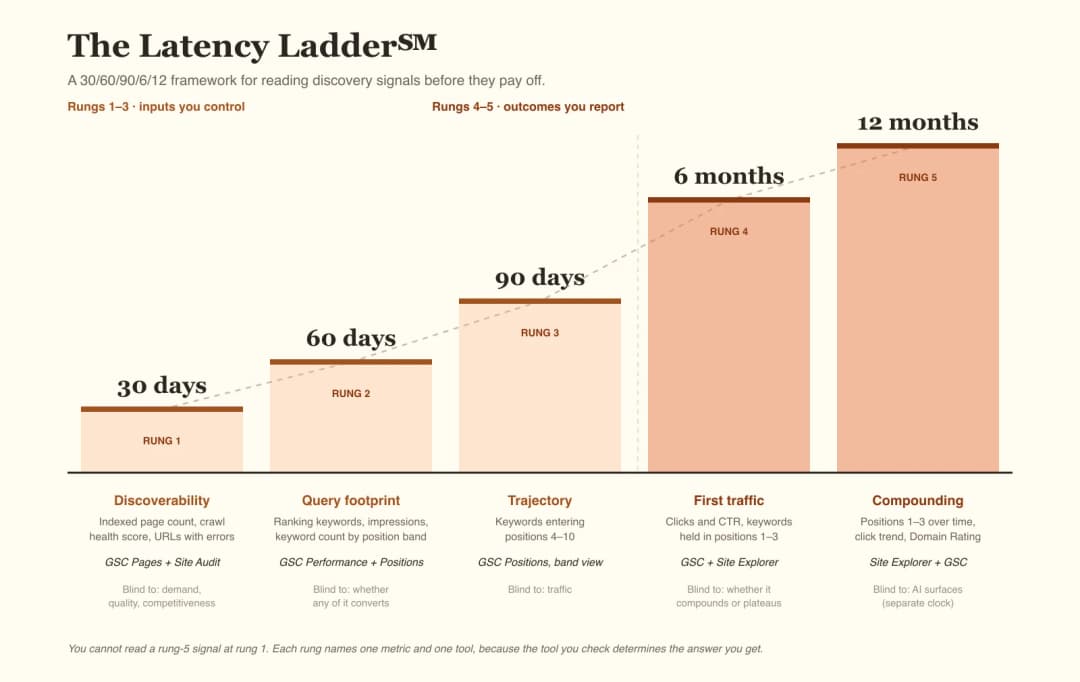
SEOThe Latency Ladder℠: A 30/60/90/6/12 Framework for Reading Discovery Signals
Clients and stakeholders always ask whether you are ranking yet, and whether AI is citing you. After nearly ten years of getting those questions, here is the framework I use to track, report, and prove the value of SEO and AI optimization — tested against my own Search Console data.
SEOWeb2 vs Web3 for Marketers: An Honest Retrospective
I wrote a lot about web3 when it was going to replace the internet. It did not. Here is the honest retrospective on web2 vs web3, what actually survived, and the two ideas still worth paying attention to.