Web3 Domains: An Honest Guide to What They Actually Do
Web3 domains were sold as the replacement for the traditional DNS system. Years later, here is what they actually do, the one real use case, and why I would not buy one for a business website.

I bought a web3 domain during the period when everyone said traditional domains were finished.
It has never resolved in a normal browser without help, and I have never used it for anything. Here is the honest guide.
What a Web3 Domain Actually Is
A record on a blockchain that maps a human readable name to an address.
The main practical function is replacing a long wallet address with a readable name. Instead of sending funds to a forty character string, you send to a name.
That is a real improvement on a real problem. It is also a much smaller thing than "replacing DNS."
The Claim vs the Reality
Claim: you own it permanently, with no renewals. Partly true. You hold a record nobody can revoke, which is genuinely different from the traditional system where a registrar or a government can seize a name.
Claim: it replaces your website address. This is where it falls apart. Browsers do not resolve these names natively. Visitors need an extension, a specific browser, or a gateway URL that defeats the entire purpose.
A business address that most people cannot type into a browser is not an address.
Claim: better for SEO. No. Search engines do not index what they cannot crawl reliably. A site behind a gateway loses more than it gains, and there is no ranking benefit to the name itself.
Claim: censorship resistance. True for the name record. Your actual content still lives somewhere, and that somewhere can be taken offline. The name survives, the site does not.
The One Real Use Case
Receiving payments.
If you accept crypto, a readable name is meaningfully better than an address string. Fewer errors, easier to share verbally, easier to put on an invoice.
That is the use case that still makes sense. It is also not a marketing use case for most businesses.
Why I Would Not Buy One for a Business
The math is simple. A traditional domain costs a small annual fee and works for every human on earth. A web3 domain costs more up front and works for a small fraction of people with specific software.
Your website needs to be reachable by someone who typed it wrong on a phone. That is the actual requirement and only one of these meets it.
If you want the name defensively, because it matches your brand and you do not want somebody else holding it, that is a reasonable few hundred dollars of trademark hygiene. Buy it and do not build on it.
What About Name Squatting Risk
This is the strongest argument for buying one and it is weaker than it sounds.
Traditional domain squatting has legal remedies through UDRP and trademark law. Web3 name squatting has essentially none, which means a squatter can hold your brand name indefinitely.
That is a real risk and the practical exposure is low, because almost nobody is looking for your business at a web3 address. The squatter has taken hostage something with very little value.
The Broader Lesson
Web3 domains are a good example of a technology solving a real problem in a narrow context, then being marketed as solving a much larger problem it does not touch.
The wallet address problem is real. The DNS replacement story was a pitch.
I keep finding this pattern in emerging tech, and the test that works is asking whether a normal person can use it without installing anything. If the answer is no, it is not a consumer-facing address system yet.
For the retrospective on the broader wave, web2 vs web3 for marketers covers what survived. For the practical side of getting found, common website mistakes that kill your SEO covers what actually affects whether people reach your site.
For the technical standard, ENS documentation explains what these names do without the marketing layer.
Should You Buy a Web3 Domain to Protect Your Brand?
Probably not, and if you do, treat it as cheap trademark hygiene rather than an investment. The squatting risk is real and the practical damage is low, because almost nobody is looking for your business at a web3 address.
The defensive argument goes like this: unlike traditional domains, there is no established dispute process, so a squatter can hold your brand name indefinitely. That is true. What makes it tolerable is that the asset they are holding has very little traffic value, and your customers will never encounter it.
If your brand is distinctive and you have the budget, buying the matching name costs modestly and removes a small annoyance. I would spend that money on almost anything else first, including a second year of your traditional domain registration and proper DNS management.
What I would definitely not do is build anything on it. A site served through a gateway URL, unreachable to most browsers and invisible to search engines, is worse than no site. The traditional domain does the work.
The broader principle applies to a lot of defensive brand spending. Buying every possible domain variation, every social handle, and every emerging namespace is an endless expense with diminishing returns. Secure the ones people will actually type and let the rest go.
The general lesson is about defensive brand spending. Buying every domain variation, social handle, and emerging namespace is an unbounded expense with sharply diminishing returns. Secure the names customers will actually type, keep your registration and DNS in order, and let the rest go. Web infrastructure for marketers covers the ones that genuinely matter.
Did you buy one? I did, and I could not tell you the last time I thought about it.
More notes
 SEO
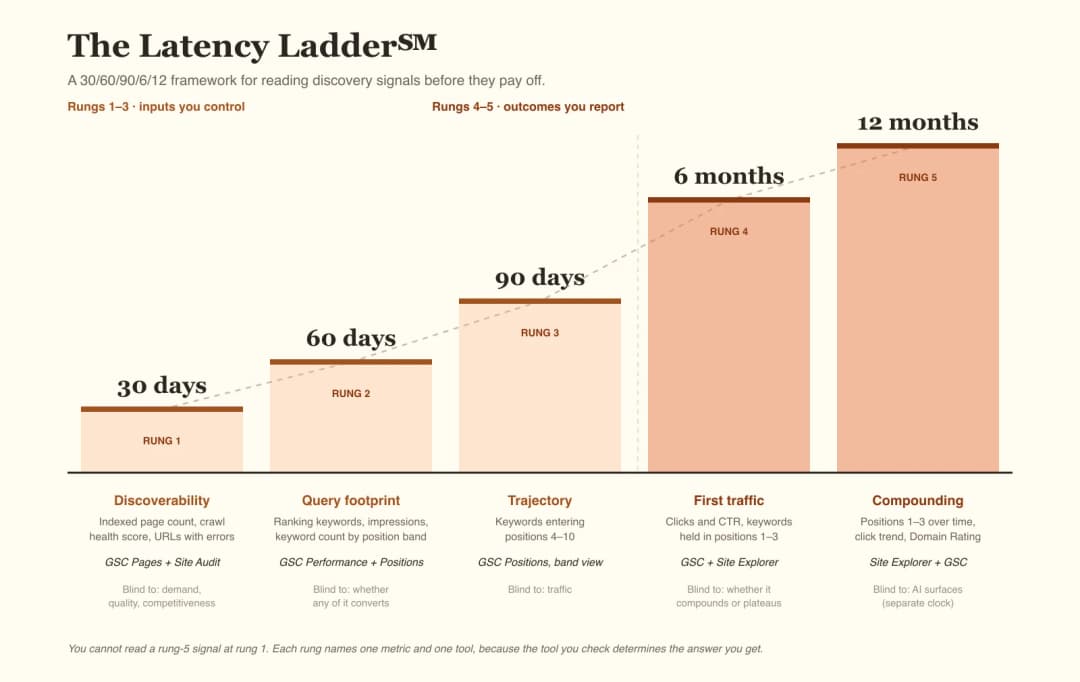
SEOThe Latency Ladder℠: A 30/60/90/6/12 Framework for Reading Discovery Signals
Clients and stakeholders always ask whether you are ranking yet, and whether AI is citing you. After nearly ten years of getting those questions, here is the framework I use to track, report, and prove the value of SEO and AI optimization — tested against my own Search Console data.
SEODecentralized Search and SEO: What Actually Changed
Decentralized search was going to break Google's monopoly and rewrite SEO. It did not happen, but search did fragment in a way nobody predicted, and that fragmentation is the thing worth preparing for.
SEOWeb2 vs Web3 for Marketers: An Honest Retrospective
I wrote a lot about web3 when it was going to replace the internet. It did not. Here is the honest retrospective on web2 vs web3, what actually survived, and the two ideas still worth paying attention to.
SEONiche Market SEO: 5 Steps That Beat Competing on Volume
Niche market SEO is the only realistic path for a site with no authority. Here are the five steps I use to find and win keywords that bigger competitors will never bother to target.