Does an AI Generated Website Hurt SEO? A Real Case Study (and the 100-Page Fix)
I ran a website entirely on AI generated content for six months. It grew, then a Google spam update sent its traffic to zero. Here's what happened, what I cut, and how it started coming back.

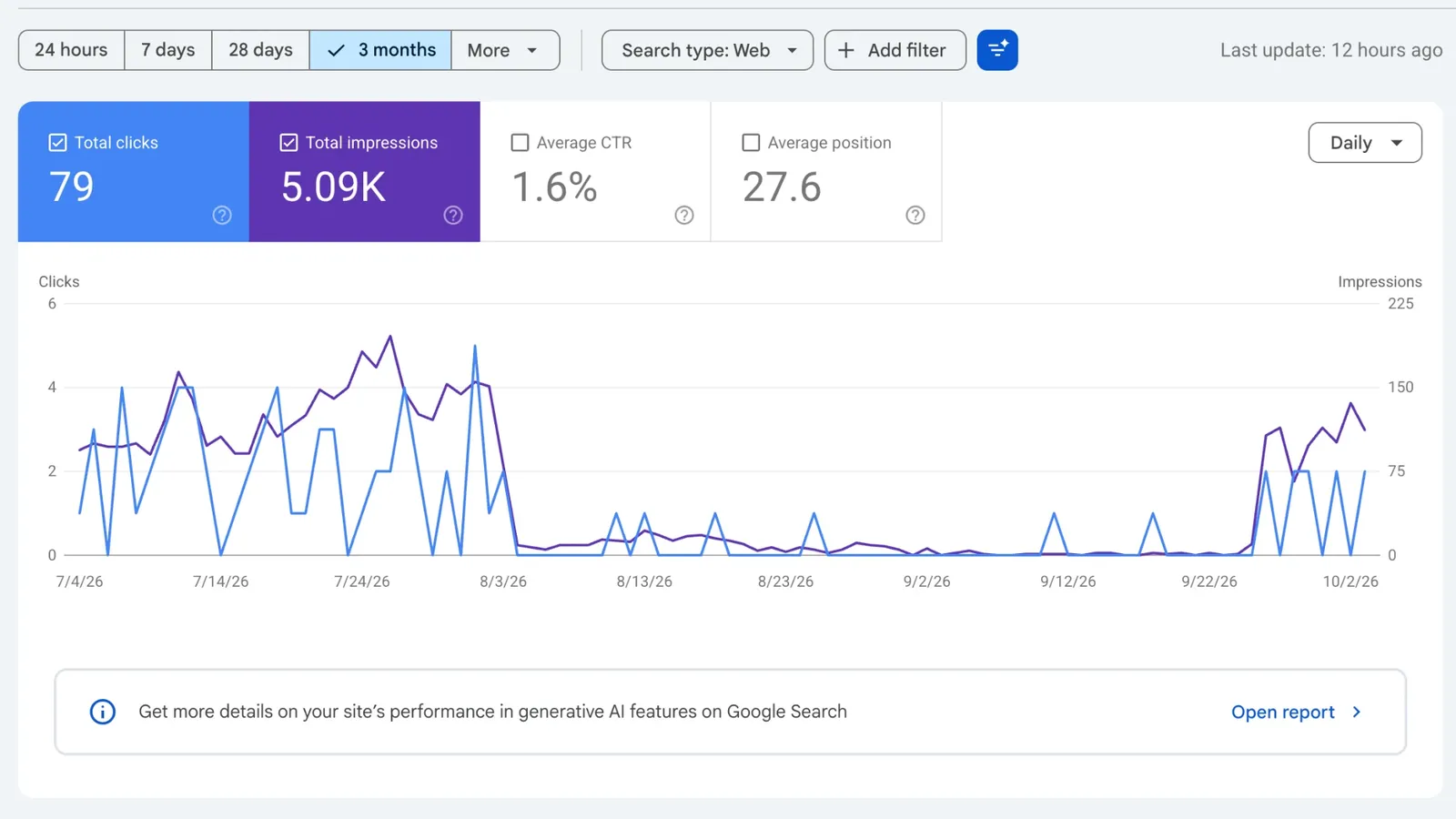 Three months of Search Console data: the drop in early August, and the rebound after I cut the AI content.
Does an AI generated website hurt SEO? I ran one to find out. For about six months, the answer looked like no. Then Google rolled out its latest spam update and the answer became a very loud yes.
This is the full case study. What I built, what the graph did, what I cut, and what I'd tell anyone thinking about letting AI write their whole site.
The Experiment: A Website Run Entirely by AI
The site is MushroomPro, and I built it with one rule. AI does everything. Openclaw picks the topics, the Draftly engine writes the posts, and the pipeline publishes them to WordPress. I wanted a clear answer to a question clients ask me all the time: can solely AI generated content actually perform in search?
I tested a handful of different publishing protocols on it over time. Different prompts, different cadences, different levels of structure. The human involvement was setup and monitoring. Nothing else.
For about six months, it worked. Clicks came in most days. Impressions climbed steadily through July, peaking near 190 a day. Nothing amazing, but real traffic for a site no human was writing.
Then the Spam Update Hit and Traffic Went to Zero
This wasn't the first warning. In June I caught the site drifting toward Google's spam patterns and ran a full audit. I added a banned-phrase list, fixed a slug-collision bug that was creating duplicates, and wrote four cornerstone posts by hand. I wrote that up in what a spam audit taught me about shipping AI content at scale. Traffic steadied, and I thought the problem was handled.
In early August, the site fell off a cliff. Daily impressions dropped from the 100 to 190 range down to single digits almost overnight. Clicks went to zero and mostly stayed there for nearly two months.
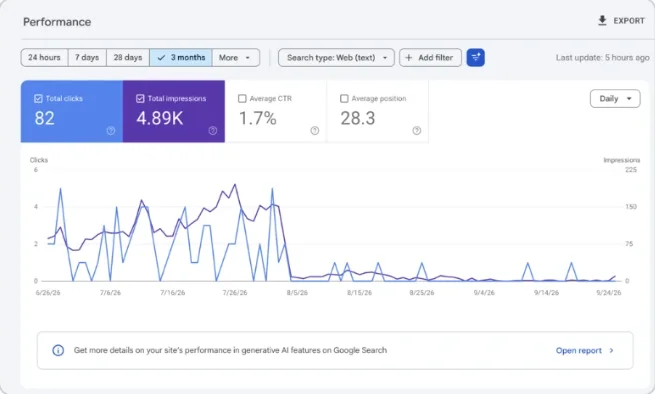 The screenshot I shared with my team on September 28. Everything after August 3rd is basically flat.
When I shared this with my team, I wrote that the site "did really well, then in the latest google search spam update, it got flagged and all traffic went to 0." That's still the most honest summary I have.
Algorithmic spam demotions are quiet. The site just stops showing up. That's why a lot of site owners don't realize what happened for weeks, and it's why I check Search Console after every announced update.
Does Google Penalize AI Generated Content?
Google's official answer is that it rewards helpful content however it's produced. That's straight from its guidance on AI content. What Google penalizes is publishing lots of pages mainly to rank, with little value added. Its spam policies call that scaled content abuse, and AI makes it very easy to commit by accident.
That's the trap. Any single AI post on my site looked fine. A hundred of them, produced by the same system with no human adding anything, looked like a content farm. Because that's what it was.
How I Fixed It: Trimming Over 100 Pieces of Content
I went through the entire website, page by page. Anything thin, repetitive, or written just to target a keyword got cut. In the end I trimmed over a hundred pieces of content.
That was a painful number. Those pages took zero effort to make, and it still felt bad to delete them. But they were the problem. Every sign pointed at the AI generated content as the thing that flagged the site.
Toward the end of September, the graph moved. Daily impressions jumped from near zero back up to the 100 to 135 range in about a week. Clicks started showing up again. Removing the AI content made the whole site look better to Google, and it started getting traction again.
How Long Does It Take to Recover From a Google Spam Update?
Expect months, and plan for a year. Google's spam update documentation says it can take months for its systems to recognize that a site now follows the rules. My impressions bounced back within weeks of the cleanup, but impressions are the early signal. Clicks and rankings take longer.
I expect it to take a full year before traffic fully rebounds on this site. The early recovery is encouraging. I'm not calling it fixed yet.
Does AI Content Hurt AIO and AI Search Visibility Too?
Yes. AI Overviews and other AI answer engines lean heavily on pages that already rank well and that search engines trust. Once Google flags a site as spam, it loses that trust everywhere at once. You can't get cited in an AI answer if the search engine behind it has decided your site isn't worth showing.
So the same rule applies to AIO, GEO, and SEO. Mass-produced AI content puts all three at risk at once. I wrote more about how those disciplines overlap in GEO vs SEO.
Should You Delete AI Generated Pages or Rewrite Them?
Delete the pages nobody would miss. Rewrite the pages that have a real reason to exist. A simple test: if a page has no traffic, no backlinks, and nothing you'd be proud to send a customer to, cut it.
Weak pages drag the whole domain down with them. Pruning feels backward when you've spent months adding pages. On my site it was the thing that turned the graph around.
Can You Use AI for SEO Content Safely?
Yes, with a human in the loop. AI is a great drafting tool. The trouble starts when nobody is reading, editing, and adding real experience before a page goes live. A good test is whether the post contains something only you could have written: a result, a screenshot, an opinion, a mistake.
My June audit fixed the phrasing, the duplicates, and the internal links. The sheer volume of AI pages stayed, and the volume is what the August update caught. If you run an audit like mine, count the pages that deserve to exist, and cut the rest.
What This Means for SEO and GEO Promises
Be very cautious of anyone promising immediate SEO or GEO results from AI generated content. My site performed for six months before it got wiped out. A vendor could have shown you that first half of the graph and called it a success story.
The real question is what happens after the next spam update. Ask any agency or tool selling AI content at volume how their sites held up through the last one. If they don't have an answer, you have yours.
Need Help Recovering From a Google Spam Update?
If your site has seen a drop like this, especially after publishing a lot of AI content, I can help you turn it around. I'll go through your site the same way I went through mine, find what's dragging it down, and build a plan to recover. You can reach out here or learn more about my SEO management services.
Have you seen an AI generated website get hit in a spam update? I want to hear what happened and how long the recovery took.
More Notes
 SEO
SEOWeb2 vs Web3 for Marketers: An Honest Retrospective
I wrote a lot about web3 when it was going to replace the internet. It did not. Here is the honest retrospective on web2 vs web3, what actually survived, and the two ideas still worth paying attention to.
 SEO
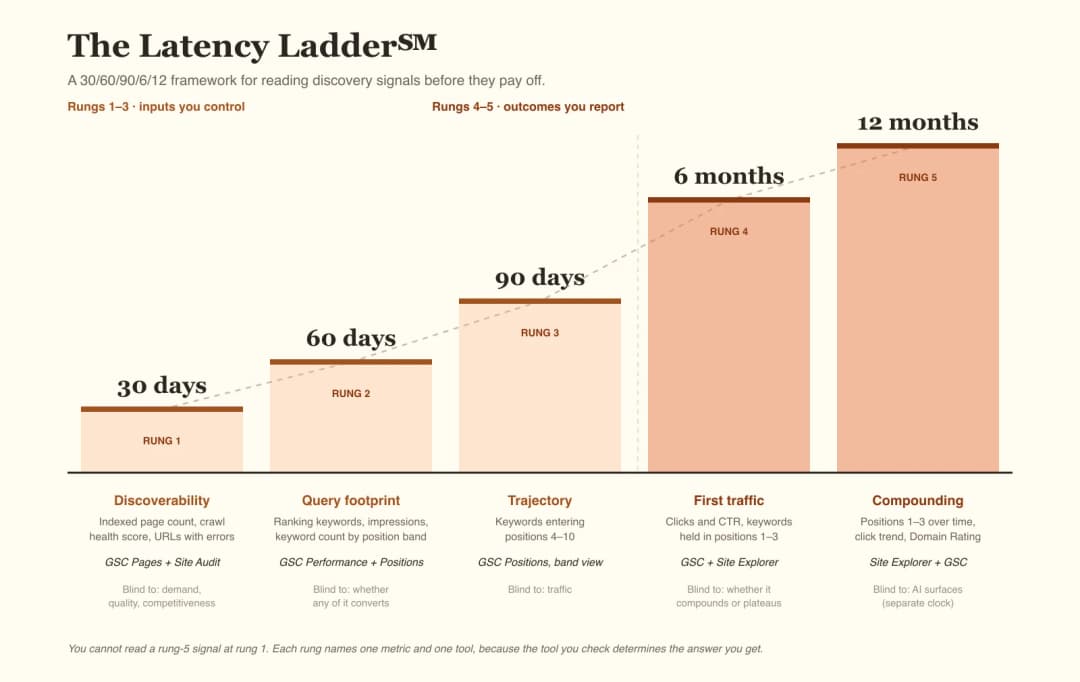
SEOThe Latency Ladder℠: A 30/60/90/6/12 Framework for Reading Discovery Signals
Clients and stakeholders always ask whether you are ranking yet, and whether AI is citing you. After nearly ten years of getting those questions, here is the framework I use to track, report, and prove the value of SEO and AI optimization — tested against my own Search Console data.
 SEO
SEOWeb3 Domains: An Honest Guide to What They Actually Do
Web3 domains were sold as the replacement for the traditional DNS system. Years later, here is what they actually do, the one real use case, and why I would not buy one for a business website.
 SEO
SEODecentralized Search and SEO: What Actually Changed
Decentralized search was going to break Google's monopoly and rewrite SEO. It did not happen, but search did fragment in a way nobody predicted, and that fragmentation is the thing worth preparing for.