Building Openclaw: One Agent, Many Pipelines, Zero Mondays at a Blank Doc
Why I stopped trying to be consistent on my own and built an agent to run my owned-media operation instead. The boundary between me and Openclaw, and what it actually catches.

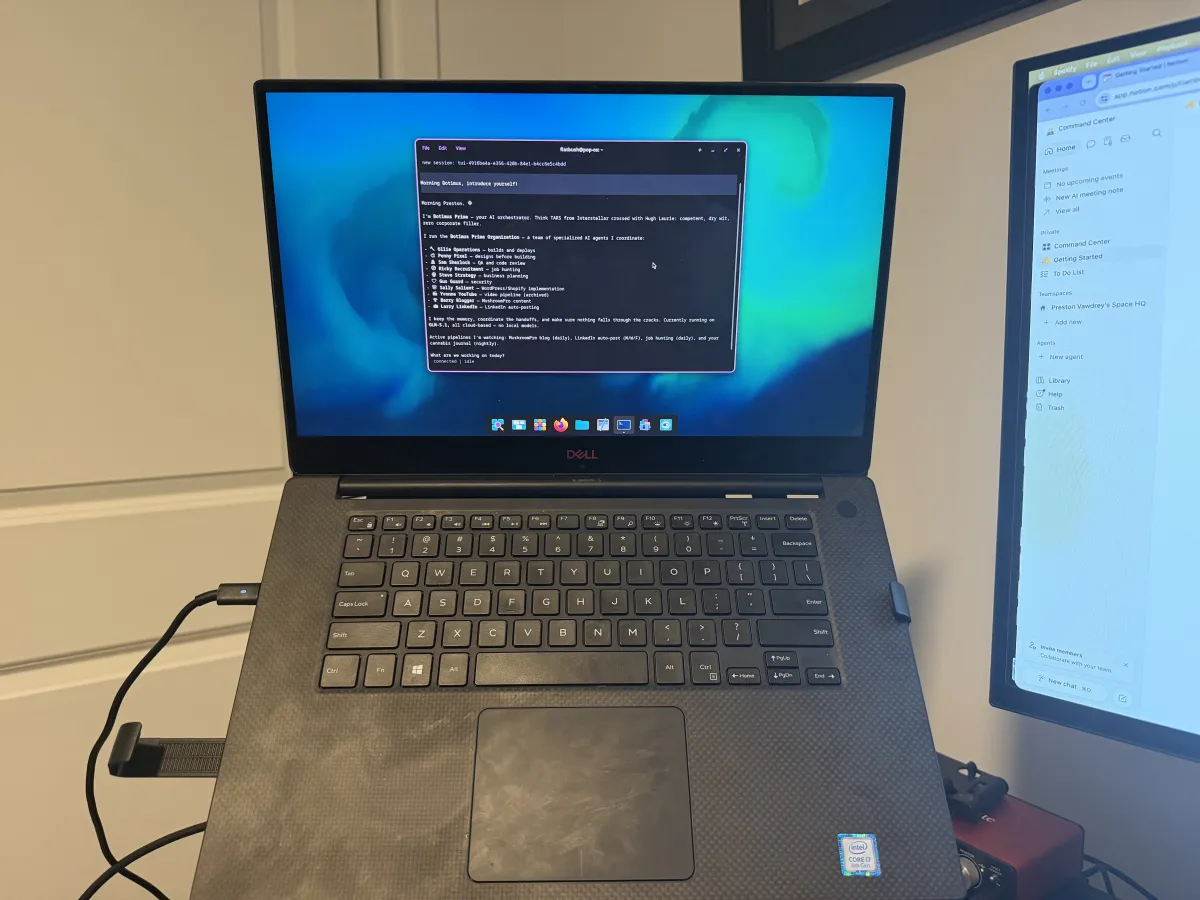
For about a year I tried to be consistent on my own. Personal LinkedIn, a couple of niche content sites, the SEO writing for client work, and the side projects I would not abandon. The pattern was always the same: a strong two weeks, a quiet two weeks, a quietly broken month, a guilty restart, repeat. I knew exactly what to publish, knew the topics, knew the angles. The blocker was never strategy. The blocker was Monday morning.
So I built an agent to handle Monday morning for me. I call it Openclaw. It is the orchestration layer that sits in front of every owned-media pipeline I publish: a personal authority engine, an automated niche blog, the audit jobs that keep the rest of them honest. Openclaw is not the part that writes. It is the part that decides what runs, when it runs, whether it actually fired, and what to do when it did not.
This post is about what changed when I drew that line.
Why I Stopped Trying to Be Consistent
Most "be consistent" advice is really "be a better version of yourself." Wake up earlier, batch your content, write in the gaps, do not skip Mondays. The advice is correct. The advice also assumes I will keep wanting to do this work for free at 6 a.m. I will not. I have done the experiment.
What I will reliably do is review work that is already most of the way there. I will edit a draft. I will reject a hook that does not land. I will catch a fact that is off. What I will not reliably do is start.
Openclaw is the answer to that asymmetry. It starts. I edit. The mismatch between what I want to do and what I will actually do gets handled by the system, not by my willpower.
The Boundary Between Me and Openclaw
The system has a small, firm boundary.
Openclaw owns: the schedule, the source signal, the first draft, the publishing call, the log of what shipped, the alert when something did not. Rubrics own the quality bar. Banned-phrase lists own the floor on AI-slop language. The publishing destinations own delivery.
I own: the rubrics. The banned-phrase lists. The angles I want pursued. The judgement calls that should never be automated, like whether a post is appropriate to publish on a day a friend lost someone, or whether an angle is too close to a client's positioning to use on my own brand. I also own the kill switch.
That last one is important. The kill switch is not a feature. It is a constraint I designed in from the start. If I ever feel like the system is publishing things I would not have published myself, I want to be able to stop everything in one command and re-tighten the rubric before turning it back on. So far I have not had to. But the option being available is part of why I trust the rest of it.
How the Pipelines Actually Talk to Each Other
This is the part I get asked about most. The honest answer is they barely talk to each other directly. They share a schedule, a log format, and a rubric library. That is it.
Each pipeline is its own job. Each one knows how to fetch its signal, draft, decide, publish, and write what it did to a shared log file. Openclaw reads the log to know what happened, and to alert me when a job that should have run did not.
What I avoided on purpose: a central database, a workflow engine, a message bus, a fancy dashboard. Every one of those would have been the kind of overengineering that kills personal projects. The whole point was to ship the simplest thing that handles Monday morning. The pipelines stay independent. They get coordinated by Openclaw because Openclaw is the only thing watching the clock and the log.
If two pipelines ever genuinely need to share state, I will add a small piece of shared state. Today they do not, so I have not.
What It Catches That a Human Wouldn't
The cases that justify the agent are not the obvious ones. They are the slow-bleeding ones.
A scheduled job that quietly stopped running because the scheduler was empty after a system change. I would not have noticed for a week. Openclaw flagged the silence in a day.
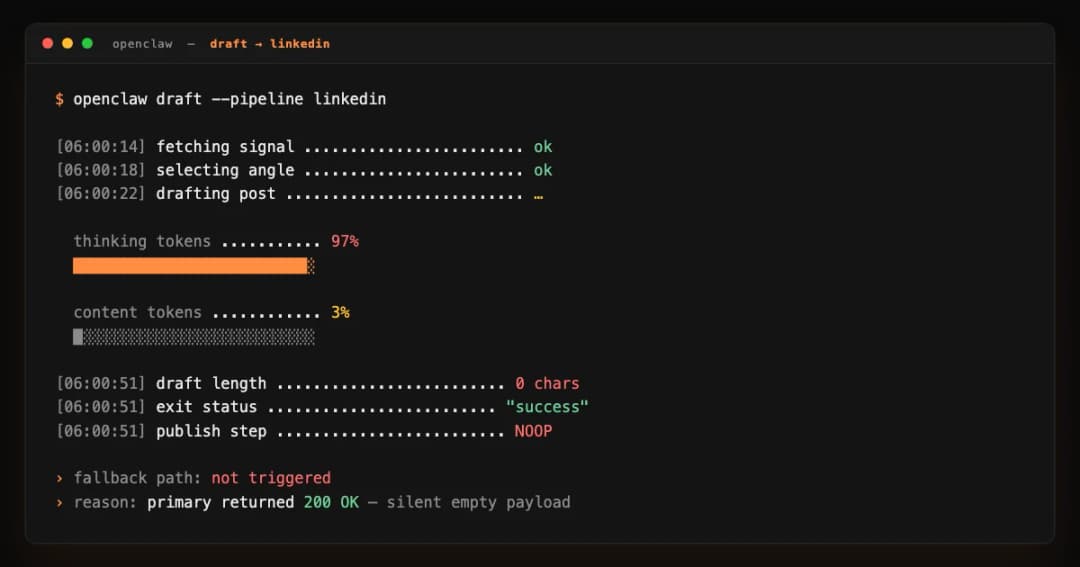
A drafting step that succeeded on paper but produced empty output because a model's intermediate reasoning consumed the entire token budget. The pipeline logged a clean success. The publishing step ran into a wall. The system caught the silent failure on the next run. I would have eventually noticed the gap on my LinkedIn feed and assumed I had simply skipped a day.
A duplicate-content issue on MushroomPro, where WordPress was silently appending suffixes to slugs when a draft happened to overlap with an existing title. The pages were ranking against each other. The audit job caught it during a routine pass. I would not have caught it until I noticed traffic flattening.
None of these are dramatic. They are exactly the kind of thing a human running the operation in their spare time would miss for months.
What It Costs to Run
The system is cheap because it is small. A handful of Python scripts. A schedule that runs them. A drafting model that I pay for by the token, with a cheaper fallback if the primary stalls. A few API calls to publishing platforms. A log file. That is it.
The expensive thing is not the infrastructure. The expensive thing is the time I spent up front making sure the rubric was right. If the rubric is wrong, the system reliably publishes the wrong things. Reliably. On a schedule. To my real account. That is the part you do not get to be lazy about.
I spend more time on the rubric than I do on the code. That is the correct ratio.
The Lesson for Other Operators
If you are reading this because you are also tired of starting from zero every Monday, here is the shape I would copy.
Pick the one piece of consistency you keep failing at. Decide what part of it can be automated and what part has to stay human. Write the human part down as a rubric, before you touch any code. Then build the smallest possible pipeline that runs the rubric on a schedule and tells you when it did not.
You will be tempted to build a dashboard. Do not. You will be tempted to wire everything to a central database. Do not. You will be tempted to add more sources, more outputs, more clever logic. Do not, until the boring version has shipped continuously for a month.
The point of an agent like Openclaw is not that it is impressive. The point is that it is still running in November when you are not.
More Notes
 AI Tools
AI Vendor Lock-In Is the Real Risk Right Now: 3 Smart Moves to Make
Anthropic is running Microsoft's old playbook on AI subscriptions, and the bill is coming. Here's what to do before AI vendor lock-in catches everyone flat-footed.
 AI Tools
The Day My AI's 'Thinking' Ate 97% of the Token Budget
A debugging story about a pipeline that logged success and posted nothing. The culprit: a reasoning model that consumed almost the entire budget on intermediate thinking before the content tokens fired.
 AI Tools
Sonnet 5 Stress Test: What It's Good At, What It's Not, and How It Compares
A Sonnet 5 stress test across the work I actually do: coding, copywriting, and tool calling, plus cost against Opus 4.8, Sonnet 4.6, GPT-5.5, GLM 5.2, MiniMax M3, and Gemini.
 AI Tools
GLM 5.2 Review: My Honest Take After Daily Use vs Opus 4.7
A GLM 5.2 review after daily use against Opus 4.7, including migrating Draftly.blog across WordPress, Vite, and Next.js. The closest thing to Claude at any price.