The Apple–OpenAI Breakup: What Tech's Messiest Divorce Teaches Marketers
Apple and OpenAI went from the biggest distribution deal in tech to a trade-secrets lawsuit in two years. Here's what the breakup teaches marketers about borrowed distribution.

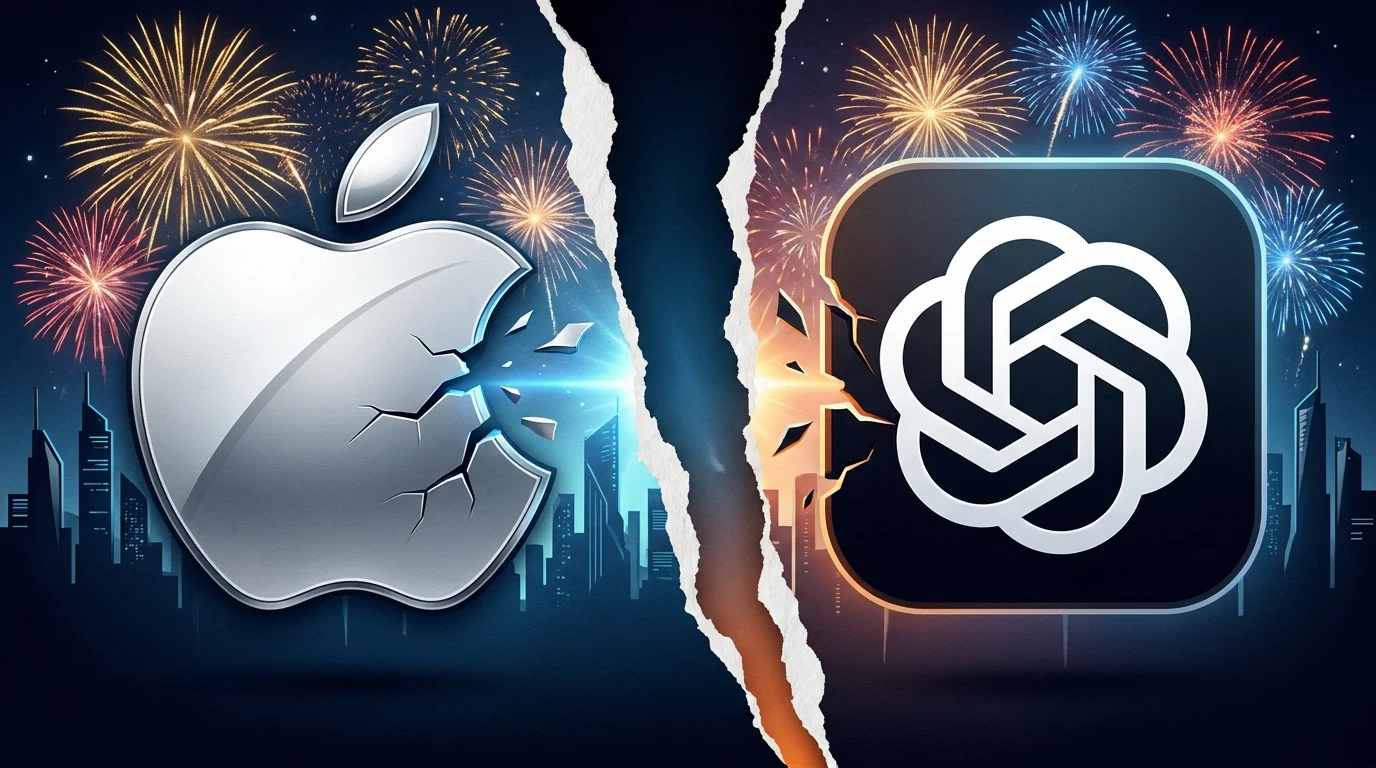 Two years ago this was the biggest handshake in tech. Today it's a court filing.
Image: generated with Higgsfield.
Two years ago this was the biggest handshake in tech. Today it's a court filing.
Image: generated with Higgsfield.
Two years ago, Apple and OpenAI announced what looked like the biggest distribution deal in the history of software: ChatGPT, baked into Siri, on over a billion devices. I remember thinking OpenAI had just won the AI race on distribution alone.
This morning, Apple sued them.
Not a strongly worded letter. An actual trade-secrets lawsuit, naming OpenAI, its hardware company, and two former Apple employees. That is a two-year arc from keynote handshake to courtroom, and if you build a business on anyone else's platform, and statistically you do, this story is worth ten minutes of your attention.
Two weeks ago I wrote about AI vendor lock-in and the risk of building your workflow on someone else's subsidized platform. This is the same lesson from the other direction. This time the one who got burned by borrowed distribution was OpenAI itself.
The Biggest Distribution Deal in Tech Lasted Two Years
Quick timeline, because the speed is the story.
In June 2024, Apple and OpenAI announced their partnership. ChatGPT would be integrated into Siri and Apple's writing tools across iPhone, iPad, and Mac. OpenAI reportedly took the deal for little or no money upfront, betting that exposure to a billion-plus devices would convert into ChatGPT subscriptions.
By May 2026, OpenAI had hired an outside law firm to explore a breach-of-contract claim against Apple. The billions in subscription revenue they expected? Per the reporting, it "hasn't come close to happening."
In June 2026, at WWDC, Apple announced the new Siri runs on Google Gemini under a deal reportedly worth around a billion dollars a year. ChatGPT got demoted from featured partner to an opt-in extension.
And on July 10, 2026, Apple filed suit against OpenAI for trade-secret theft.
Announcement to lawsuit in about 25 months. Keep that number in mind the next time someone pitches you a "strategic partnership."
Why the Marriage Actually Fell Apart
On paper, the deal made perfect sense. Apple needed AI credibility fast, and OpenAI needed distribution. Classic partnership logic: you have what I need, I have what you need.
In practice, Apple never really let OpenAI in the door.
To get a ChatGPT answer out of Siri, users had to explicitly invoke ChatGPT by name. The responses were stripped down compared to the actual ChatGPT app. And OpenAI executives reportedly felt Apple barely marketed the integration at all.
None of that should surprise anyone who has watched Apple operate for twenty years. Apple does not share the customer relationship. Ask the record labels, the app developers, or the news publishers. OpenAI signed a deal where their product was buried one layer deep inside someone else's interface, invisible unless summoned by name, and they were somehow surprised when it produced no revenue.
Here is the marketing translation: an integration is not distribution. Being technically available to a billion people is worthless if the platform controls whether anyone actually sees you. OpenAI got shelf placement in the world's biggest store, on the bottom shelf, behind a curtain, with no signage.
Replaced at the Keynote
The WWDC announcement last month was the public divorce filing. Apple's new Siri routes simple requests to Apple's own on-device models, mid-tier stuff through their Private Cloud Compute, and the heavy queries to Google Gemini. ChatGPT survives only as one of several opt-in extensions, sitting alongside Claude and Grok like just another app in a dropdown.
Think about what that swap means. Apple looked at the two-year ChatGPT experiment, decided the "partnership" model of featuring one AI brand was a mistake, and replaced it with a paid infrastructure deal. Google is not getting brand placement in Siri. Google is getting a check. Apple keeps the customer, the interface, and the credit.
That is the mature version of platform economics: the platform pays for capability and owns the relationship. The partner either gets paid like a supplier or gets nothing like a partner.
OpenAI got the second option, and worse, they got the demotion announced on the biggest stage in tech.
Then It Got Genuinely Ugly
Today's lawsuit is where a business-model dispute turned into a knife fight.
Apple's complaint names OpenAI, io Products (the hardware company OpenAI is building its first device with), and two former Apple employees. One is Tang Tan, who spent 24 years at Apple and left as VP of product design for iPhone and Apple Watch. The other is an engineer who, per the filing, kept his Apple-issued laptop after leaving and used it to download confidential technical documents.
The complaint alleges the scheme ran "at every level": using Apple's confidential project code names in recruiting, asking job candidates to bring Apple hardware components to interviews, and coaching departing employees on how to dodge Apple's security procedures. OpenAI has hired away dozens of Apple hardware people to build its io device, which was supposed to ship in the first half of 2026.
I have no idea who wins in court, and neither does anyone writing about it today. But notice what the lawsuit is really about: the moment the partnership stopped being useful, both companies pivoted straight into competing for the same future, and all that accumulated resentment needed somewhere to go.
3 Lessons for Anyone Building on Borrowed Distribution
You are probably not signing billion-dollar keynote deals. But if your business depends on Google rankings, Meta ads, Amazon listings, an app store, or an AI assistant recommending you, then you are OpenAI in this story, not Apple. Three things to take away.
1. Distribution you don't own is a rental, and the landlord can renovate. OpenAI had the best AI product in the world and access to a billion devices, and it converted to roughly nothing because Apple controlled the interface. Your Instagram following, your marketplace listings, your position in AI-generated answers, all of it works the same way. Keep building the channels where you own the relationship: your email list, your site, your community. Boring advice. Also the only advice that survived every platform shift of the last twenty years.
2. In any partnership, the default position is the whole game. The difference between "ChatGPT is Siri's brain" and "ChatGPT is available if users say the magic word" turned out to be the difference between billions and basically nothing. When you negotiate placement anywhere, a reseller deal, a co-marketing agreement, an integration, fight for the default and be honest with yourself about what opt-in placement is actually worth. Usually it is worth close to zero.
3. Watch where the defaults move, because your customers already did. Starting with iOS 27, the default AI answering questions on the world's most valuable install base is Gemini. If part of your traffic strategy is being found and recommended by AI assistants, the assistant that matters on iPhone just changed vendors overnight. Nobody asked your permission, and there is no migration guide. The only defense is paying attention and diversifying before you are forced to.
The Uncomfortable Question
If OpenAI, the most-hyped company on the planet, with the most-used AI product in history, could not turn a partnership with Apple into real revenue because they did not control the interface, what makes any of us think our platform dependencies are safe?
Take an honest inventory this week: how much of your revenue arrives through a channel where someone else controls the defaults? If the answer scares you a little, good. That is the useful kind of scared.
Figuring out that mix, and fixing it before a keynote fixes it for you, is exactly the kind of work I do as a fractional CMO. Take a look at my fractional CMO services if you want another set of eyes on your channel risk.
Where is your business most exposed to someone else's breakup?
More Notes
 AI Tools
Sonnet 5 Stress Test: What It's Good At, What It's Not, and How It Compares
A Sonnet 5 stress test across the work I actually do: coding, copywriting, and tool calling, plus cost against Opus 4.8, Sonnet 4.6, GPT-5.5, GLM 5.2, MiniMax M3, and Gemini.
 AI Tools
AI Vendor Lock-In Is the Real Risk Right Now: 3 Smart Moves to Make
Anthropic is running Microsoft's old playbook on AI subscriptions, and the bill is coming. Here's what to do before AI vendor lock-in catches everyone flat-footed.
 AI Tools
Building Openclaw: One Agent, Many Pipelines, Zero Mondays at a Blank Doc
Why I stopped trying to be consistent on my own and built an agent to run my owned-media operation instead. The boundary between me and Openclaw, and what it actually catches.
 AI Tools
Opus 5 Is Just Fable 5 but Cheaper, in Both Directions
After a full build session on Opus 5, my verdict is that it's Fable 5 at a fraction of the price. The discount is real, and so is what you give up for it.