The Five Guys Testimonial Theory: How to Earn Brand Reputation
A Five Guys testimonial wall taught me how to build brand equity, and why displaying your brand reputation everywhere matters more than where the testimonials come from.

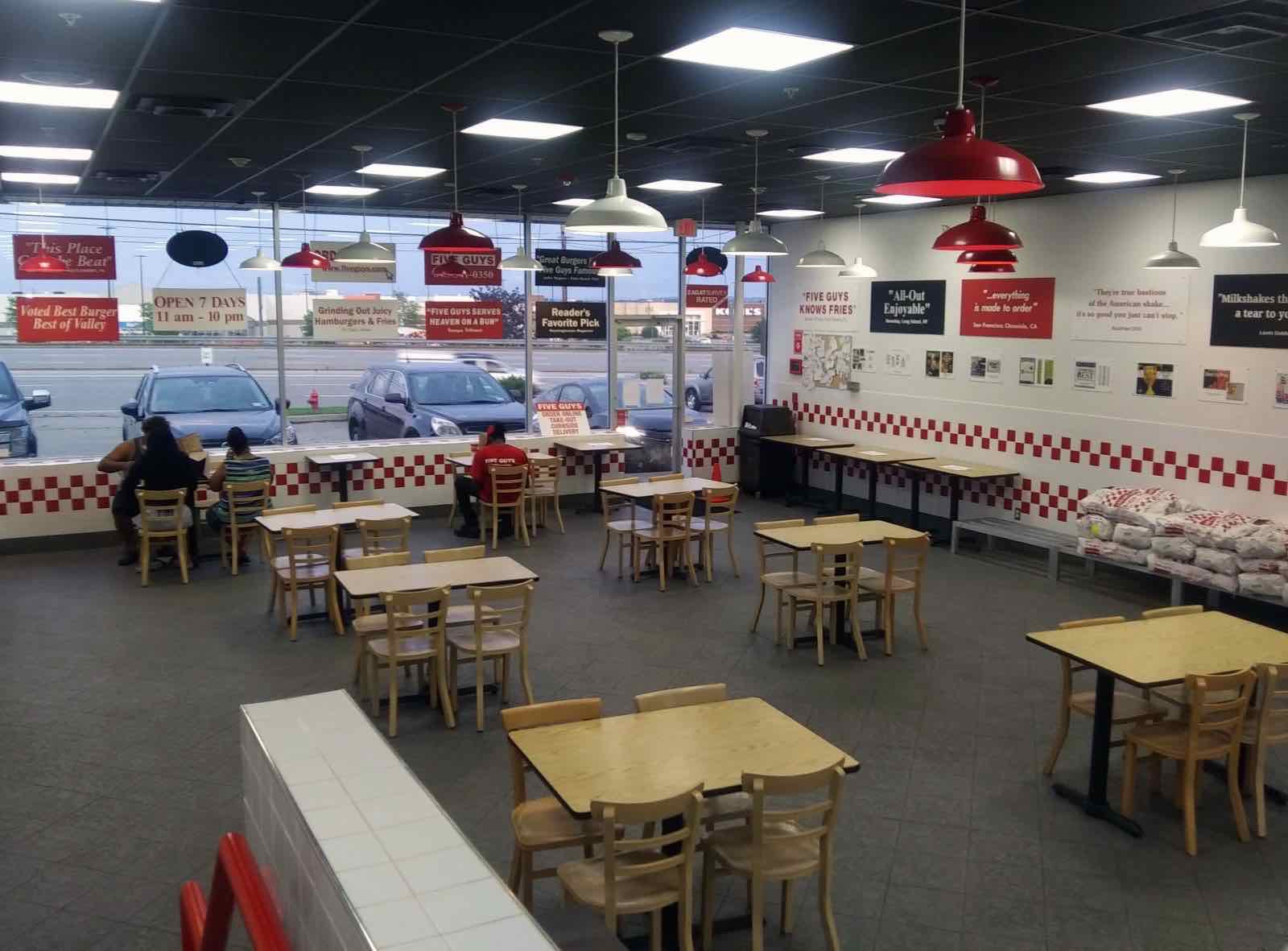 Walk into any Five Guys and the walls tell you what other people think of the burger before you've even ordered one.
Photo: Daniel Case, CC BY-SA 4.0, via Wikimedia Commons.
Walk into any Five Guys and the walls tell you what other people think of the burger before you've even ordered one.
Photo: Daniel Case, CC BY-SA 4.0, via Wikimedia Commons.
The last time I was at Five Guys, halfway through a bacon cheeseburger, I started reading the walls.
Press quotes. Voted Best Burger. Reader's Favorite Pick.
Framed clippings from newspapers in places I've never been. I sat there scanning every one of them and noticed something. Not a single testimonial was from Utah, where I live, where I was sitting, where I'd just paid for the burger.
For a second I almost cared. Then I had a more interesting thought. What if it doesn't matter?
What I Noticed at Five Guys (and Why It Stuck)
It does matter. Obviously it matters. But only so much.
That wall isn't there to convince me a Long Island critic loved their fries. It's there because Five Guys understands something most businesses never get around to doing on purpose.
Visible proof is the entire game. Proof you didn't write yourself. Proof that lives somewhere your customer can see it the second they walk in.
The reviews don't have to be from Utah. They just have to be there.
The bigger question is how to build brand equity that survives a customer's first thirty seconds with you. Because that wall is doing more for Five Guys than any ad they could buy.
Testimonials on the Wall Are Testimonials on a Website
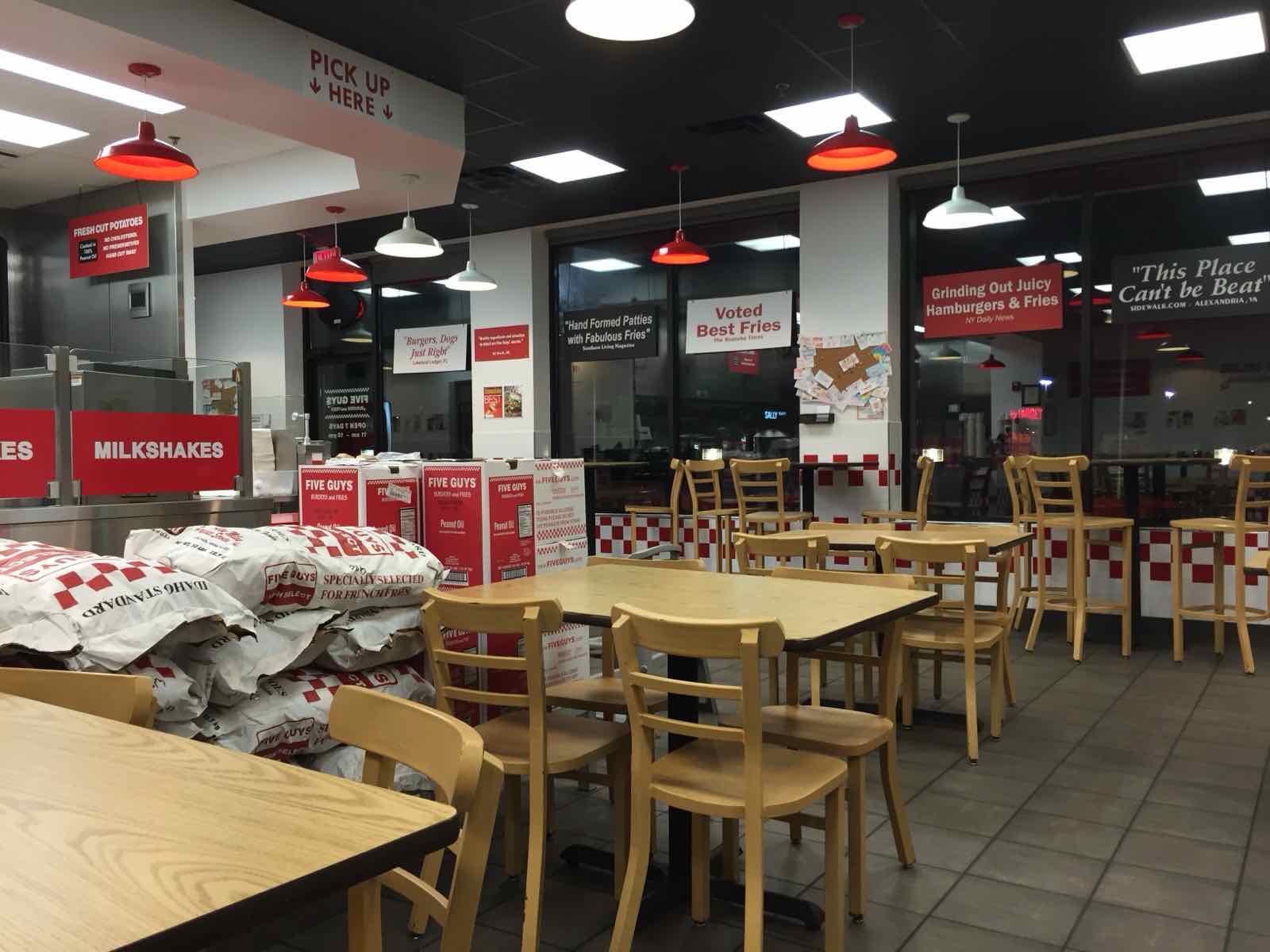 The wall isn't an afterthought. It's the brand telling you who they are before you read the menu.
Photo: Narek75, CC BY-SA 4.0, via Wikimedia Commons.
The wall isn't an afterthought. It's the brand telling you who they are before you read the menu.
Photo: Narek75, CC BY-SA 4.0, via Wikimedia Commons.
If you've spent any time online, you already know what's coming.
Most of us, somewhere in the back of our brains, half-suspect the testimonials on a homepage are curated.
Maybe the photo is stock. Maybe the quote got tightened up. Maybe the customer was nudged toward the words on the page.
We know this. We've all been on the other side of that email asking for a review.
And we respond to testimonials anyway.
That's how social proof works. Seeing a wall of quotes that captures what's specifically good about a brand isn't a logical exercise. You walk in suspicious and walk out a little more willing.
The Five Guys diner doesn't read the wall and run a fact check. They glance at it, register that other people decided this place was worth talking about, and lift the burger to their mouth with slightly more confidence than they had ninety seconds ago.
The wall does its work before anyone says a word.
I Don't Advocate for Fake Reviews (and Neither Should You)
To be clear, every testimonial on my own site is real. I'd push every client toward the same standard. The voice of the customer is the single best marketing asset you'll ever have, and faking it cheapens the only currency a brand actually owns.
That said, testimonials aren't just persuasion. They're signaling. They're the same thing as the little padlock icon and the "Secure Payment by Stripe" badge at checkout.
 Testimonials are the security badge of brand reputation. You don't read them, you just look for the icons.
Photo: Kindel Media via Pexels.
Testimonials are the security badge of brand reputation. You don't read them, you just look for the icons.
Photo: Kindel Media via Pexels.
You don't read those either. You don't audit Stripe's compliance certifications before buying a t-shirt. You just expect the icons to be there.
When they're missing, you get a queasy feeling and your finger hovers over the back button.
Any real brand reputation strategy starts with that idea. Customers don't grade your testimonials, they look for their presence.
If your homepage has no quotes, no logos, no screenshots, no review counts, no faces, the silence is what they hear. And what they hear is, "this place might not be worth the risk."
You don't need ten thousand reviews. You need enough of the right ones, in the right places, to clear the security-badge bar. After that, the conversation changes.
The Five Guys Theory of Brand Equity
Brand equity is hard. It's built one happy customer at a time, over months and years, with consistency you can't fake. There's no shortcut.
But once you've earned it, once you have real customers saying useful things about your product, brand equity in marketing doesn't mean anything if you don't use it.
Sitting on testimonials in a Google Doc is the marketing equivalent of money you never spend. It can't compound in a folder. It's not doing the job until it's visible.
The theory is simple. Earn it. Then display it everywhere a customer could possibly intersect with your brand:
- On the homepage hero, not buried on an /about page.
- On the pricing page, right next to the number that gives people pause.
- In the checkout flow, where doubt creeps back in at the last second.
- In ad creative, where you're a stranger asking for attention.
- In your email signature, your proposals, your sales decks, your packaging.
- On the literal wall of your literal store, like Five Guys.
Those framed quotes at Five Guys are a thesis statement. They say, "we are the kind of place other people write about, and we'd like you to know that before you bite in."
Call it confidence, call it marketing literacy. Either way, it works.
How to Build Brand Equity You Can Actually Display
If you want a system rather than a theory, here's the practical spine for how to build brand equity that earns its way onto the wall.
- Ask for testimonials at the moment of delight, not weeks later. Right after a win, right after the result. That's when the words come out specific and emotional and quotable, not when the customer is trying to remember what month you finished the project.
- Collect specific stories, not generic praise. "Doubled our qualified leads in six weeks" beats "great to work with" every time. Specific is what cuts through.
- Display them where the decision happens. A testimonial above the fold on a product page outperforms a testimonial-wall page nobody visits. Move them to where the cursor is hovering over the buy button.
- Refresh them. Quotes from 2018 make a brand look stagnant. Roll new ones in quarterly so it stays a signal that the work is ongoing.
- Mix the formats. Quote, video, logo wall, screenshot of a Slack message, a real review with a real star count. Different proof works on different people.
Do this and you stop debating whether to "add a testimonial section." You start treating proof like a real part of the product experience.
Put the Proof on the Wall
Brand equity is the only marketing asset that compounds. Most businesses earn it and immediately bury it.
Walk into a Five Guys and you can't miss what they think of themselves. Their wall is a thesis statement, framed and re-framed and stacked next to the napkin dispenser.
They earned the press. Then they put it everywhere you could see it.
If you've built something customers genuinely love, the next move is visibility. Put the proof on the wall, the homepage, the checkout, the email, the deck.
Being good in private isn't enough. The proof has to do its job in public for the equity to compound at all.
If you're trying to figure out where the gaps are in your own brand's proof, what to collect, where to display it, how to make it part of every customer touchpoint, that's exactly the kind of work I do as a fractional CMO. Take a look at my fractional CMO services, or read more on how a marketing-optimized website earns its keep, and let's talk.
More Notes
 Marketing Strategy
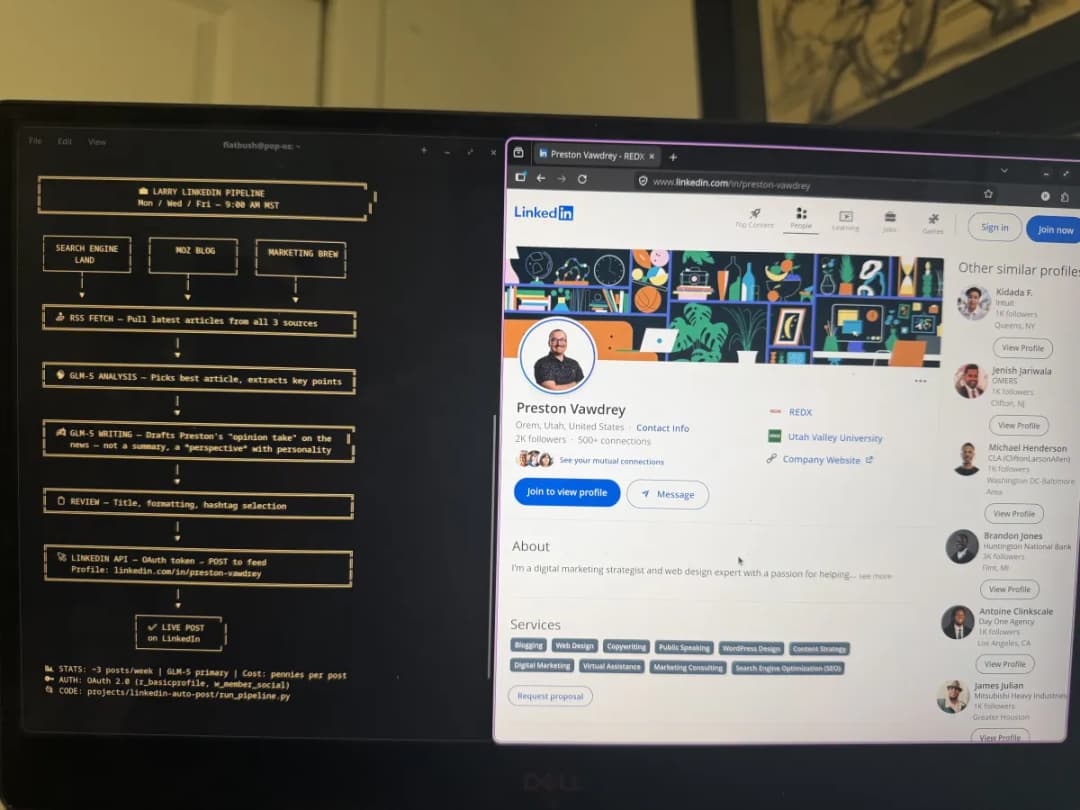
How My LinkedIn Account Posts Three Times a Week Without Me
The pipeline behind my Mon/Wed/Fri LinkedIn posts. The rubric that does most of the work, the banned-phrase list that saved the account, and what I still do by hand.
 Marketing Strategy
What Is a Fractional CMO?
A fractional CMO gives growing businesses senior marketing leadership without the cost of a full-time executive. Here's what a fractional CMO does, who needs one, and how the model works.
 Marketing Strategy
Audio Branding: The Channel Most Small Businesses Ignore
Audio branding is treated as something only large companies do. The mechanics are cheap and the attention landscape has shifted toward audio. Here is what is actually worth doing at a small business scale.
 Marketing Strategy
What Tech Layoffs Actually Signal About Marketing Budgets
Big tech layoffs get read as a recession signal. Usually they are a reallocation signal, and reading them correctly tells you where marketing budgets are moving before your competitors notice.